
By Debora Heim
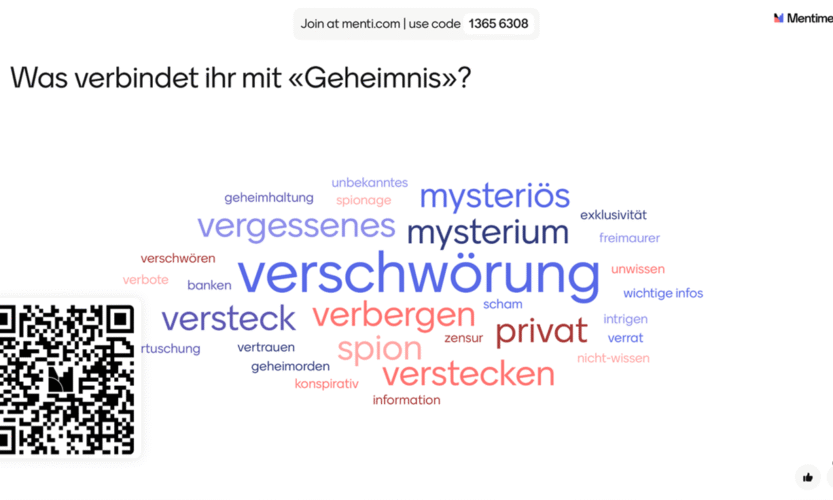
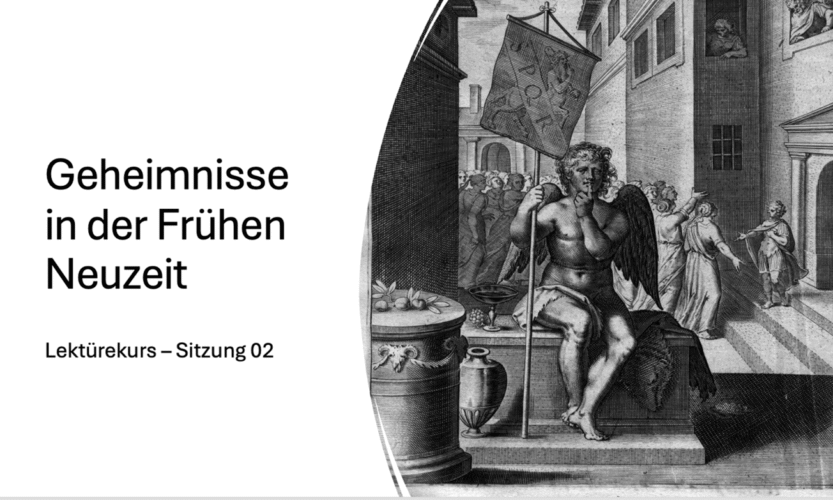
What is a secret? A hidden truth, a social practice, a technology of power — or simply something unsaid? The reading course “Secrets in the Early Modern Period” at the University of Berne sets out to explore these questions and, in doing so, reveals how profoundly secrecy shaped the world between the fifteenth and eighteenth centuries. As historian Daniel Jütte aptly called it, this was the “Zeitalter der Geheimnisse.” From alchemical laboratories to political councils, from devotional writings to coded correspondence, secrecy was not merely an exception: it was a cultural principle.
But this course is not only about the history of secrets; it is also about how we read. Every secret, after all, demands interpretation. The act of reading itself becomes an analytical tool and, in a sense, a metaphor for unveiling what lies concealed.
Part I: Tracing the Terrain of Secrecy
The first part of the course opens with an exploration of the “Zeitalter der Geheimnisse.” In early modern Europe, secrecy permeated a remarkable range of contexts — from religious ideas and philosophical reflection to political theory, medicine, and artisanal knowledge. Through selected readings, students examine political, economic, bodily, and communicative aspects of secrecy and reflect on how these domains intersected.
In this phase, we encounter the concept of the early modern «economy of secrets», with its professori de’ secreti, alchemists and cryptologists trying to gain profit from their secrets; we study the connections between the belief in divine secrets and the rise of early modern science, and we encounter early examples of industrial espionage. Central to these discussions is a conceptual question: what exactly is a secret, and how can it be defined and studied historically.
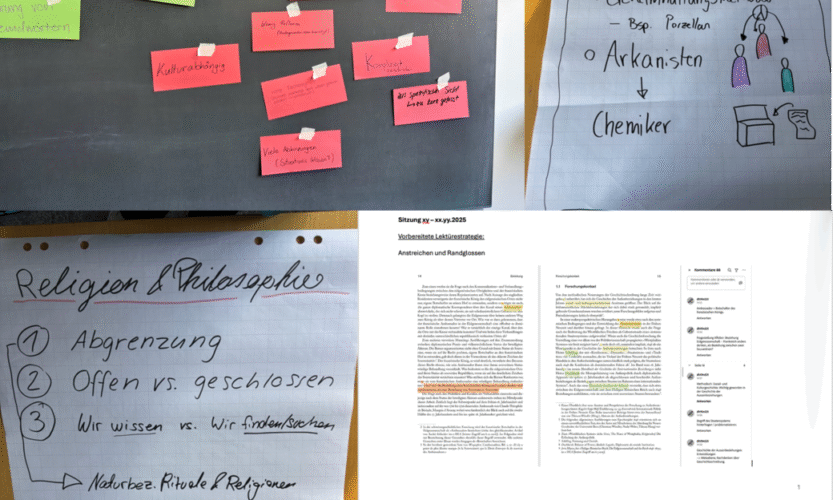
Alongside these thematic explorations, participants practice different reading strategies — annotation, structured note-taking, the PQ4R method, and visual mapping — which serve as analytical tools for grasping complex historical material. Reading, here, becomes both a scholarly technique and a metaphor for deciphering what remains hidden.
Part II: Exploring Early Modern Secrets in Detail
The second part deepens both the thematic and methodological engagement. Each week, a group of students becomes “experts,” introducing background material and leading discussions on the session’s texts. With every meeting, a new reading technique is practiced and reflected upon in a learning journal: What worked? What resisted comprehension? What remains opaque?
This cumulative process leads toward the final assignment: a short essay in which students formulate their own research question and critically engage with at least three texts from the course. The essay thus becomes a space where reading turns into writing, and where the act of interpretation itself generates new knowledge.
Making Secrets Visible
A course like this is not about delivering ready-made answers. It is about tracing patterns, interpreting silences, and learning to listen to what remains hidden between the lines. The two-part structure mirrors the dynamic of secrecy itself: first the exploration of its many faces, then the deep dive into its mechanisms and meanings.
Perhaps that is the true secret of this course — that through reading, discussing, and writing, we learn not only to reveal what was once concealed, but also to appreciate the subtle art of how knowledge keeps itself hidden.
Article written by Leo Mader